A locked clubhouse, donated flagsticks, and the fight over one of America’s most important public golf courses.
Last updated Nov. 25, 2026. Court dates and the operator situation may change.
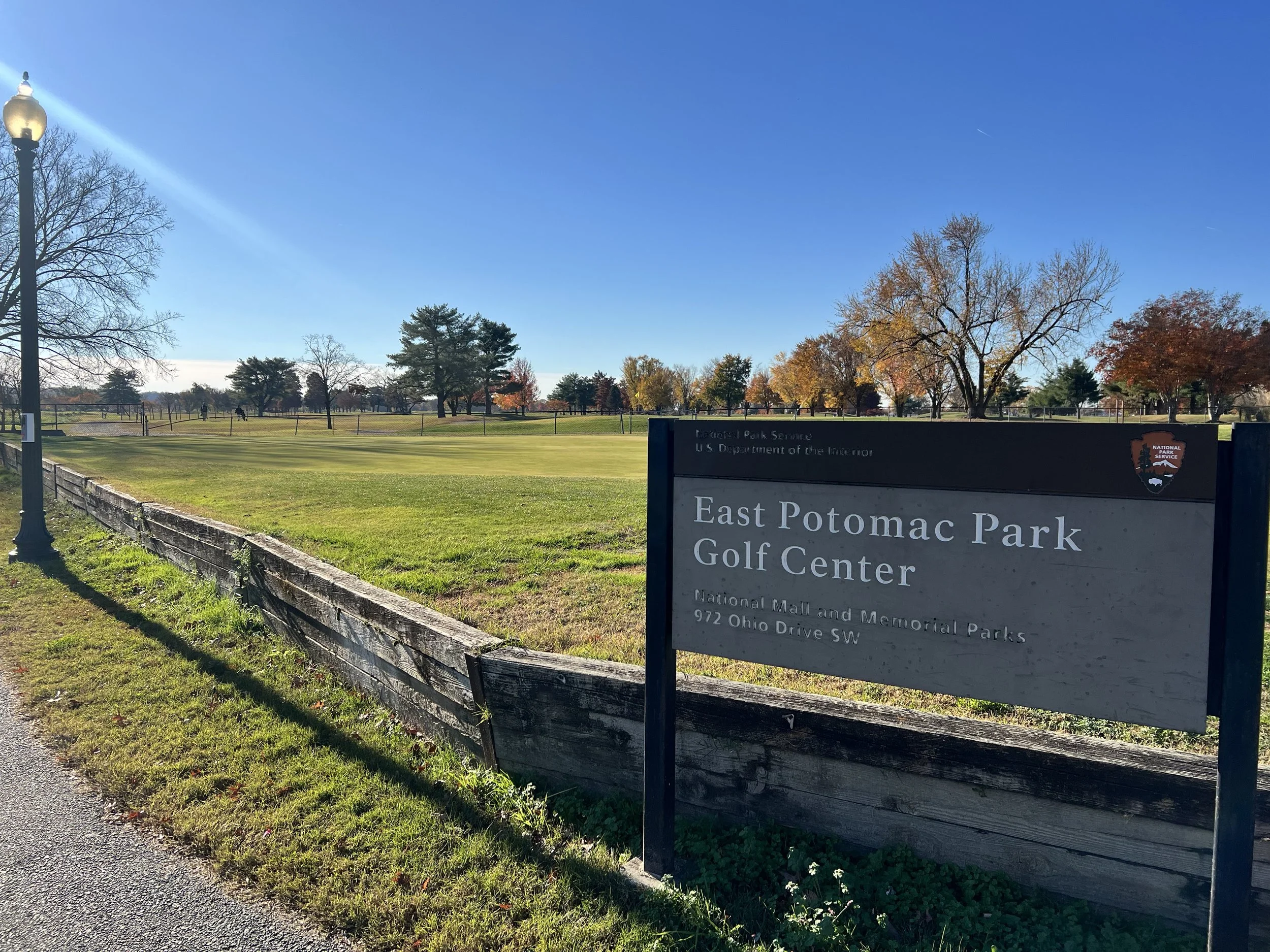
I was in Washington, D.C., on Monday, November 23, 2026, for the Bengals’ Monday Night Football game. East Potomac Golf Links had been on my list ever since I came across the story at work, so I stopped to play a few holes.
What I found was not a normal muni round. The clubhouse was locked. There was no starter, no staff, and no official flags. On the pins I did see, the “flags” were golf towels. Someone had left a handwritten sign that read, in pretty rough handwriting, “Hand off East Po.” And people were still out there playing.
East Potomac sits on National Park Service land in East Potomac Park, on the Hains Point peninsula — an 18-hole Blue Course, a nine-hole White Course, and a par-3 Red Course.
A public course designed by Walter J. Travis began construction in 1917, paused for World War I, and opened its first nine holes to the public in July 1920. A round cost 25 cents, locker room included. The Park Service has long described the point of D.C.’s public courses as golf for people who could not afford a private-club membership.
It was not open equally at first. Beginning in 1921, Black golfers were limited to restricted hours on one day a week. In June 1941, Asa Williams, George Williams, and Cecil R. Shamwell insisted on playing East Potomac and finished 18 holes under police escort. The next day, Interior Secretary Harold Ickes ordered the city’s public courses open regardless of race. The Park Service has said that protest “opened the door for the full integration of all national park facilities in 1945.”
Before the operator left this month, a round here ran about $17 to $48, depending on which course and the day. The Blue Course was $42 on weekdays and $48 on weekends for adults.
In 2020, a nonprofit called the National Links Trust took on a 50-year lease to operate East Potomac, along with two other D.C. munis, Langston and Rock Creek. The Trust and its supporters say they put more than $8 million into the three courses and more than doubled rounds and revenue over five seasons.
On December 30, 2025, the Interior Department terminated that lease, saying the Trust had failed to complete required capital improvements. The Trust has disputed that. It kept running East Potomac on an interim basis until November 15, after the Park Service signed a new lease for Rock Creek and Langston only. After play that Sunday, the flags, pins, and cups came out, and the clubhouse was locked. Golfers started showing up anyway.
The Trump administration — mainly the Interior Department and the National Park Service — wants to redevelop East Potomac into a championship-level public course designed by Tom Fazio. The official concept would replace the existing 36 holes on three courses with one 18-hole, par-72 layout measuring 8,105 yards from the tips, running to the seawall and across Hains Point. Officials say the goal is a “safe, affordable, world-class public golf course” in the mold of Torrey Pines, Bethpage Black, and Memorial Park.
Some of the condition concerns are documented. A 2026 Park Service assessment recorded 110 deficiencies, 69 of them Critical or Urgent, plus 84 fire-and-life-safety issues, 48 of them in the clubhouse. The seawall is described as severely deteriorated, with a $304.5 million replacement in the concept book, separate from the unpublished golf-construction budget. I can see that the property needs work.
What’s not in the proposal is a green fee. The administration has not published what it would cost to play the new course. The president has said locals would get a 50 percent discount, with no posted base price. The concept book instead points to “benchmark” championship munis — weekend rates of about $90 for residents and $322 for everyone else at Torrey Pines South, $80 / $160 at Bethpage Black, and $38 / $140 at Memorial Park — and says a similar two-tier structure “could keep local rates low.” In court, the government has said those figures were illustrations, not a posted price.
The concept would also cut off the Ohio Drive loop to the end of Hains Point, which has runners, cyclists, and other park users just as concerned as the golfers. None of this is final.
In February, the D.C. Preservation League and local golfers sued. On November 14, U.S. District Judge Ana C. Reyes issued a temporary restraining order, hours before a planned 15-month closure. The order keeps the park open; it does not require the government to operate the golf course. On the Monday I was there, she extended that order through December 12 and set a hearing for December 8. You can still walk onto East Potomac, with no operator or staff. Regulars have been keeping it playable with donated cups, flags, and pins from courses in Maryland and Virginia.
The pressure picked up the day after my round. On November 24, President Trump posted on Truth Social calling East Potomac “Trash Island,” criticizing Judge Reyes, and saying the renovation “must be started, IMMEDIATELY.” He again said the new course would be public, with a “substantially reduced rate” for D.C. residents, but still didn’t name a green fee. That same afternoon, The Washington Post reported that nine congressional Democrats, including Sens. Chris Van Hollen and Angela Alsobrooks, Rep. Jamie Raskin, and Del. Eleanor Holmes Norton, had written to Interior Secretary Doug Burgum and the acting Park Service director asking them to keep formal golf operations going while the case plays out, and to set the championship plan aside. As of this writing, the administration hasn’t publicly responded.
I’m not going to pretend I played a tournament-ready golf course. The fairways and rough were patchy, dry, and not flush. That’s real. But the greens surprised me. The operator’s last day was November 15. I was there on the 23rd — more than a week later — and the greens were a little long, and they rolled well.
President Trump has called East Potomac “the Worst Golf Course anywhere in the World.” He’s also called it “Trash Island.” I’ve seen much worse than what I walked on November 23. Neither line matches the greens I putted on.
The question isn’t whether East Potomac could be improved. It’s what you give up to get a championship layout — and who that course is still for.
What should a public course in the nation’s capital be: a championship venue, or the affordable place that gets people into golf? I’d love to hear your take.
— Jonny Blair, Blair’s Back Nine
Sources and further reading
National Park Service Cultural Landscape Inventory, East Potomac Park Golf Course (PDF)
WUSA9, “First look at Trump’s East Potomac plan, and what the public gives up,” Nov. 3, 2026
GOLF.com, “Judge blocks President Trump’s plan to redevelop East Potomac Golf Links,” Nov. 15, 2026
FOX 5 DC, “D.C.’s East Potomac Park to remain open through Dec. 12,” Nov. 23, 2026
The Fried Egg, “Local Golfers Pick Up the Slack at East Potomac,” Nov. 24, 2026
Golf Digest, “One of America’s great munys is now a ghost course,” Nov. 19, 2026
NPR, “Trump’s East Potomac vision alarms D.C. runners, cyclists, birders,” Oct. 23, 2026
Golf Post, East Potomac green fees and redesign reporting, Sept. 18, 2026
Donald Trump, Truth Social post on East Potomac, Nov. 24, 2026
The Washington Post, report on the congressional Democrats’ East Potomac letter, Nov. 24, 2026